Wednesday, 12 September 2012

I've been to Bali too

And then I went to Bali.
Two weeks after returning from London.
And before I go any further I assure you that my life doesn't usually look like this, but for various reasons this is how the timing happened.
The main reason being the 40th birthday of a close friend,  Bali being deemed to be a great meeting point for both Australian and English contingents.
Although heavily weighing in our favour.
Now I don't know about you, but my first trip to Bali was only two years ago. And it was only due to heavy campaigning by a friend that I agreed to go.
Prior to that I had always dismissed Bali as the not-my-type-of-Aussie holiday destination.
But thank God my friend persevered.
For now I am a convert, and aim to spend a week there annually.


We stayed at the luxurious Sentosa Private Villas in Seminyak.
After the overheated and hectic airport experience, followed by an arctic air-conditioned airport bus ride, the serene and seemingly temperate environs of this resort were a welcome relief.


There is a little bit of cultural cross-polination which can be slightly challenging for the purist, however, the overall effect was really very beautiful and soothing. 
The Japanese pond with large paving stones and coy carp set the tone upon entry.
I wasn't sure about the large stone figure, which we lazily described as Buddha, however, as Bali is a Hindu enclave in a Muslim state, other possibilities clearly abound.


The quadrangle of bedrooms and shared living space around the private pool nods ever so slightly to a Dutch-Indonesian colonial aesthetic. And if you've read any of my previous postings you will know how I feel about a colonial reference.


I especially loved the bedrooms. 
Complete with mosquito-net canopied four poster beds and multiple gold cushions a la Anouska Hempel (the bolster being one of my favourite touches), it felt Asian and ancient Roman all at once.
And while I hesitate to use the unimaginative 'east meets west' it crazily managed to achieve this in a cohesive way.

So with this, and our inflatable Havaiana, as our base, this group of Aussie holiday makers enjoyed a week of Balinese merriment.


Friday, 17 August 2012

Final trip of the trip

My final cultural outing, after a whirlwind tour of eating, shopping and gallery-hopping, was a nostalgic one for me.
I saw the Wallace Collection.
It had been the very first museum I had visited on my first trip to London, 23 years ago. I was with my mother, who had ensured that I saw as much London-specific culture as possible, limiting time for the 'frivolous' pursuits of shopping and bar-hopping: "You can do that anywhere!"
One of her favourites, the Wallace Collection, remained in my memory as one of my favourites as well, however, despite numerous trips to the UK since, I did not return until this year.


The collection's home is Hertford House, a magnificent 18th century abode, at the crown of Manchester Square, just off Hinde Street (perhaps another explanation for the enduring appeal of this museum to my family) slap bang in the middle of central London. It has been much added to over the years but still retains its overall elegant Georgian country house feel, which, as you've probably worked out by now, I can be all about.
The interior and the collection, however, go beyond elegance to extreme opulence.


The collection comprises artworks, decorative objects, furniture, sculpture, ceramics, arms and armoury collected over almost 2 centuries by the four Marquesses of Hertford and Sir Richard Wallace (illegitimate son of the 4th Marquess). It was bequeathed to the nation by Lady Wallace in 1897. One of the conditions of the bequest was that the collection must remain intact, no piece ever to be removed or added.
As a result the collection is displayed very much as it would have been at the time that the house was inhabited by its original owners.

The French furniture is the most dominant and defining feature of the collection, and is said to be one of the finest and most significant in the world, and it was this that I was most interested to see. However, although I had remembered there to be an abundance of rococo elegance, the reality of excessive baroque ornateness provided a level of sumptuousness that was too rich to fully absorb.
Especially at the end of an exhausting, albeit stimulating trip.

So I shamefully admit that I did in fact only skim the surface of this important collection. There were of course many highlights, and three particular standouts.

And I am now being somewhat lazy in my writing about them, but I know that I couldn't have done it better than the museum's catalogue descriptions.


"Perhaps the finest and most important example of the Rococco style in the decorative arts in the Wallace Collection, this commode was delivered by Gaudreaus for Louis XV’s new bedchamber in April 1739. A design for the commode attributed to the sculptor Sébastien-Antoine Slodtz, now in the Bibliothèque Nationale, reveals that the mounts were originally intended to be much more symmetrical. However, as executed by the master bronzier Caffiéri, they are wildly exuberant and seem to grow organically in every direction over the surface of the commode. Louis XV, as he lay dying in his bed, is said to have thought that in the flickering firelight, the mounts looked like the flames of hell. The commode was inherited by the King’s First Gentleman of the Bedchamber, the duc d’Aumont, who probably replaced the original red and grey marble top with this one of serpentine marble."

I've always loved this shape of piece, and was first introduced to it properly during my time working with anqtiques. The word commode always intrigued me though as I had always felt it to be like a very posh, very old pre-cursor to the port-a-loo. Clearly the word has other applications.
And of course it is a privilege to see one of the finest and earliest examples of a shape that is so popular today, in pieces with a range of merit. 


"Delivered by Riesener on 8 July 1780 for Marie-Antoinette at Versailles, this drop-front writing desk is one of several similar pieces, some stamped by Jean-François Oeben and some by Riesener (who took over his workshop after Oeben’s death), all produced between the early 1760s and 1780. The transitional style of the desk, with its elaborate acanthus mounts and iconographical marquetry including the cockerel of France on the drop-front contrasting with the neo-classical male mounts on either side and marquetry urns on the lower doors, indicates that it would have been largely out-of-date as soon as it was delivered in 1780. Indeed, Marie-Antoinette only kept the piece in her cabinet intérieur or private study for three years, before replacing it with another, more feminine desk now also in the Wallace Collection." 

Jean-Henri Riesener was one of the most celebrated, and possibly finest, 'ebenistes' (cabinet makers) in 18th century France. And I do love the concept of a secretaire, roughly translating to secretary, so called not as one may think for the writing of letters, but for the keeping of secrets, hence the drop-front writing table, which locks to conceal the contents.
I also did pause to wonder at the procurement of this piece. Despite the English sympathy towards the French aristocracy's plight at the hands of the revolutionaries, they may have been keen to snap up some bargains post 1792.


"This grand wardrobe is one of two in the Wallace Collection. The main purpose of the piece was for display, but it was also fitted with shelves for storing linen or other items. The figurative, gilt-bronze mounts on the centre of the doors represent Apollo and Daphne and Apollo flaying Marsyas, mythological stories derived from Ovid’s Metamorphoses. Boulle himself was a compulsive collector and owned a series of drawings after the Metamorphoses by Raphael, destroyed in his workshop fire of 1720. The wardrobe was once in the collection of the Duke of Buckingham at Stowe House. The interior was lined with peach blossom silk and fitted with gilt-bronze brackets and hooks to hold the clothes of Queen Victoria when she visited in 1845, three years before the 4th Marquess purchased the wardrobe."

Andre-Charles Boulle was another of the most celebrated cabinet makers of 18th century France, and is largely acclaimed for perfecting marquetry inlay in furniture, specifically inlay of brass and tortoiseshell.
This was therefore the perfect finale before heading back to reality, home and to work, for you know how we feel about all things gold and animal related at Becker Minty.


Wednesday, 8 August 2012

Migrations

The second exhibition of the day, called Migrations: Journeys Into British Art, held so much promise for me. Described in the blurb as exploring the impact of migration on British art, I was left with the misunderstanding that this exhibition would showcase colonial art.
My mistake, as I cast only a quick glance.
As you may know from previous blog postings, I do love anything British Empire and Colonial, so I was a little excited, especially given that the Tate is known for housing such pieces.

Johan Zoffany, Colonel Mordaunt's Cock Match, c 1785


Alas, 'twas not to be. The true theme had been the impact on British art of artists migrating to Britain through the ages, which although conceptually interesting, did not excite and challenge me in quite the same way as the Picasso exhibition had. Despite its being a natural extension of the theme of the Picasso exhibition, going so far as to celebrate the contribution of foreign artists to British art


Obvious, and of course beautiful, examples can be seen in the influence of Dutch, Flemish and other continental painters on portaiture from the Renaissance and beyond.

Hans Holbein, Anne of Cleves, c 1539
Anthony van Dyck, Charles I, 1636 

My most notable reaction was the realisation that all the 'foreign' names in British art were so entrenched in the annals of British art history that their 'foreignness' went unnoticed.

And the two works that I liked the most were paintings whose origin I would have unidentified incorrectly were it not for the catalogue.

Tissot, Portsmouth Dockyard, c 1877

James Tissot was French born, of Italian heritage, and mainly worked in France, where he lived and died. But both these works show English harbour scenes in Portsmouth, and although showing a decidedly French style, reminiscent of Manet and Toulouse Lautrec, also display the easy wealth of the American bourgeoisie so frequently displayed in American art of the period.


Tuesday, 7 August 2012

Who would have thought?


My second cultural expedition came the day after visiting the Saatchi Gallery, and saw me taking in the flagship gallery of the Tate Britain, mentioned in a previous blog posting.
There were a number of exhibitions running at this time, however two of them were of particular interest to me: Picasso & Modern British Art, and Migrations.

Picasso & Modern British Art was a beautifully and uniquely curated show, exploring the reciprocal influence of Picasso and modern British artists.
Obviously I did not pay due diligence in my long ago completed Art History degree, for although I was aware of similar themes prevailing in the UK and on the continent during the 20th century, I was totally unaware of an ongoing visual discourse between Picasso and his British contemporaries.

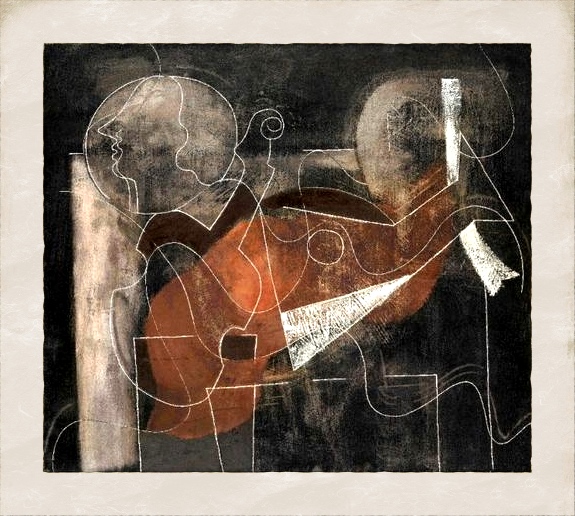
Below are three examples of Picasso's works alongside those of his British counterparts that were real standouts of the exhibition.


Picasso, The Source, 1921

Henry Moore, Reclining Figure, 1936

Picasso, Three Dancers, 1925
Francis Bacon, Crucifixion, 1933


Picasso, Still Life With A Guitar, 1924

Ben Nicholson, Coin & Musical Instruments, 1933


Several pictures clearly say several thousand words, and will say them so much better than I will in an under-qualified art theory discourse. But I do hope showing these images together shares some of the inspiration and edification I experienced when seeing them in this exceptionally interesting and beautiful exhibition.
Particularly poignant when you consider that the Tate is renowned for a leading collection of British art since 1500.


Wednesday, 18 July 2012

The Grand Old Duke of York

My first cultural outing saw me taking in the wonder that is the Saatchi Gallery, also in Chelsea.
I had originally anticipated it being a space in which was showcased a rotating selection of Charles and Doris Saatchi's private art collection.
But no.
It is in fact a gallery created to exhibit the works of emerging or little known contemporary British artists, and contemporary artists from elsewhere who are relatively unknown in the UK.
First established over 25 years ago, the Gallery has been in its current location since 2008.
And that location is magnificent.


Adjacent to a sprawling luscious lawn, the gallery is housed in the former of Duke of York's Headquarters, an elegant late Georgian building (completed 1801), complete with so many of my favourite features, including beautifully aged red brick, fan light windows and a Pantheon-like portico popped on the front.
The interior, however, does kind of kill me. Very few signs of the original interior remain, and I am all about a traditional architectural feature.
However, I do love the original being juxtaposed to the contemporary, particularly when done so unapologetically, where the contrast gives integrity to both styles, and they appear seamlessly joined.


Of course, of greater import are the works on show. And of all the amazing pieces I saw the one that resonated the most for me was this incredible installation. It is a site specific installation that occupies the entirety of a single massive room. It is the work of Richard Wilson, one of Britain's most celebrated sculptors


The immediate effect of the work on the viewer is one of great calm, despite having very little idea what the work actually is. And to describe it won't do it justice, but I'll try.

The railing you see in the above image is on the purpose built viewing mezzanine. 
The thin black line you see around the perimeter and the pillar is the rim of a tray fixed to the wall. This tray is filled with oil. And the effect, although mildly confusing, is in fact mesmerising. For what appears on the surface of the oil is in fact the reflection of everything above the tray.
The oil, although shallow, conveys a sense of a bottomless pool.

And into this pool is submerged a sunken and tapering walkway to nowhere.

I am not an art critic, so I won't endeavour to 'explain' this work. But I did enjoy how it deeply challenged notions of space and texture, in an incredibly provoking way, but without causing any discomfort. 

The Saatchi Gallery, and this work specifically, is absolutely one of the major highlights of my trip.


Monday, 16 July 2012

Cheers in Chelsea

Next stop Tom's Kitchen in Chelsea - fabulous casual brasserie style eatery, and rumoured haunt of a courting Wills and Kate.

Part of the empire of celebrity chef Tom Aikens, this is exactly my style of restaurant.
You can drink at the bar without having to order any food.
If you do order the food it is absolutely sensational.
The service is perfect. The exact right balance of professional, familiar and attentive.


And the environment is great: although I feel we are at risk of overdoing the whole industrial look right now, I really like the way it's done here.
The space is theoretically a little overstuffed, but in an orderly fashion.
And the elements, although potentially disparate, come together beautifully.
Industrial fans and lights amongst painted pillars.
Subway tiles with wood panelling.
Rusted courtyard mirrors alongside Old Master replicas.
All of which create the perfect mood for any tone.

Which really works for me, because I can be all about anything from a quick tete a tete over a glass of wine to a long and noisy boozy lunch, and Tom's Kitchen offers all of this.


A trip down St Martin's Lane

First port of call was to the much celebrated St Martin's Lane Hotel, to collect another traveling Australian.
As you may imagine it is on St Martin's Lane, which is in Covent Garden, in the West End, the traditional home of the performing arts in London.
This area was just pumping.
All day and all night.
There seems little evidence of the recession we all know Britain to be in, and the warmth and sunshine had neutralised the much publicised negativity from locals towards the upcoming Olympics.

The St Martin's Lane Hotel is in an unassuming building that resembles government offices, or low rent accommodation. The only exterior evidence of the luxury that lies within comes in the form of a perfect pair of topiary plants at the main entrance.


But upon walking through that revolving glass door, you are instantly transported into a cool, quiet sanctuary. The expansive space is defiant in its mere presence, given the crowds outside, and the tiny inner city dwellings for which this city is known.
Designed by Philippe Starck, who I've always felt is appropriately named, it does have that ultra modern cool concrete thing going on, of which I am not a big fan.
However, the palette, the opulent Louis inspired furniture and the witty touches in the other pieces bring warmth and personality, making it inviting and comforting.

And although I felt way too uncool to actually stay there, my traveling companion and I enjoyed the refuge provided by the foyer, the bar and the restaurant on several occasions.